Dossier · The roots of the Movement
Eight centuries of charity
The history of the Confraternities of Misericordia, from their birth in Florence in 1244 to the volunteering of today: almost eight centuries of men and women serving their neighbour.
Begin the storyThe Misericordie are among the oldest volunteer associations in the world: a tradition of charity that has lasted almost eight centuries, always in the spirit of the Works of Mercy and of practical help for those who suffer.
It is not the story of a few heroes, but of a whole people: porters and grand dukes, popes and craftsmen, who wore the same robe and gave the same service, with no distinction of rank. The Misericordia di Ariccia, founded in 1994, is a recent link in this very long chain.
The story
The timeline
Eight centuries at a glance: from medieval origins to today's Misericordie, step by step.
- 1244 The origins
The first Misericordia is born in Florence
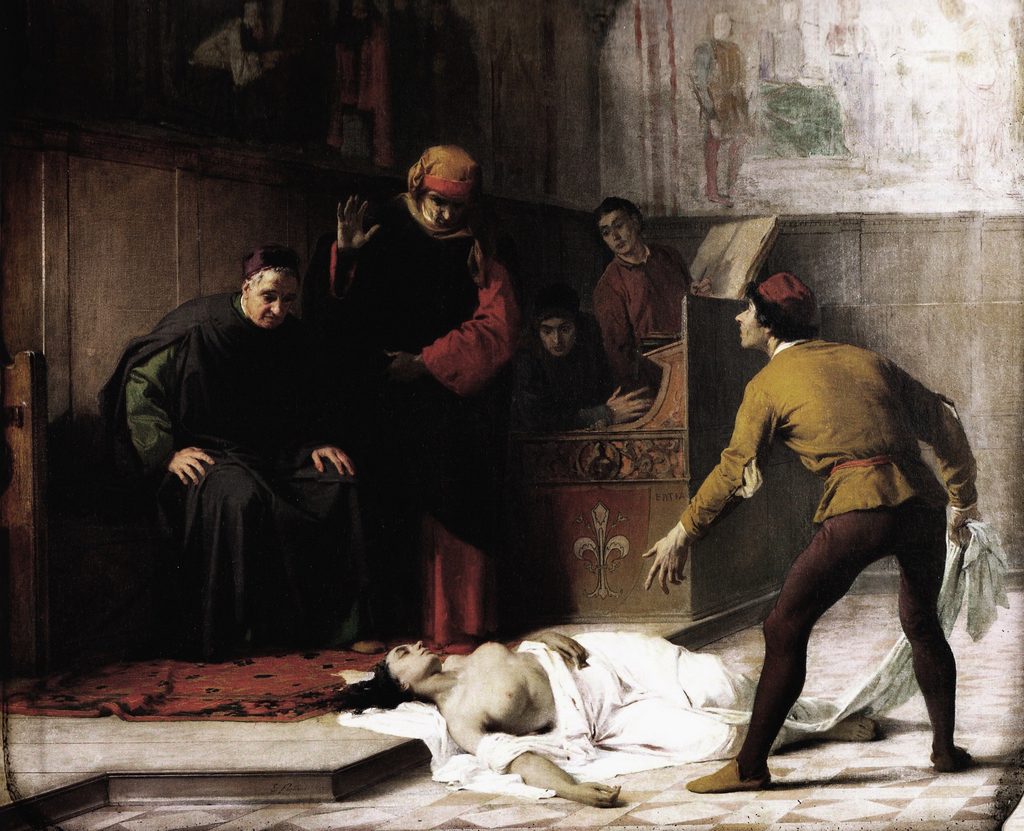
«Origin of the Company of the Misericordia in Florence» (*Origine della Compagnia della Misericordia in Firenze*), Eleuterio Pagliano (19th century).Public domain · Wikimedia Commons In the High Middle Ages, amid the struggles between Empire and Papacy, companies and brotherhoods of the faithful flourish in the Florence of the free communes. Into this setting comes the Dominican friar Peter of Verona (Pietro da Verona), who gives shape to the spontaneous associations of the Florentines and draws up the first Constitutions of the Misericordia, ensuring that it conforms to the Church. This is the act that turns a popular impulse into an institution built to last. Peter would be proclaimed a saint in 1253 as Saint Peter Martyr. - The legend The origins
The porter Piero Borsi and the six baskets
Popular tradition credits the initiative to Piero Borsi, a porter of the Wool Guild (Arte della Lana). With the companions who gathered at the Buca degli Adimari, a wine tavern near the cathedral, he introduced a fine for anyone who blasphemed. With the money collected they bought six zane (wicker baskets) to carry the sick to hospital: and so, in the people’s memory, the Company began. History and legend are intertwined, but the message is clear: charity grows from the ground up, from the hands of working people. - 1321 The Middle Ages
The first document
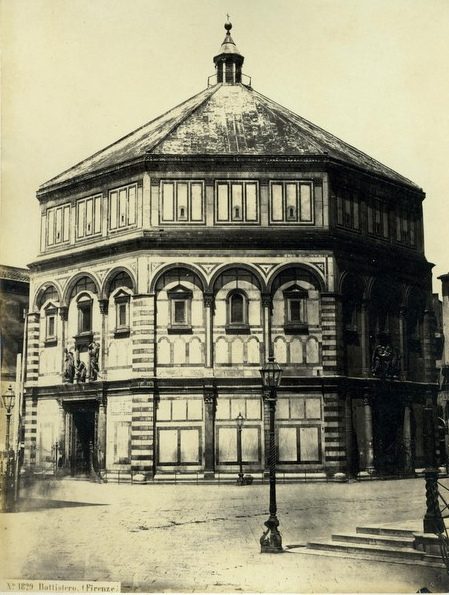
The Baptistery of Florence: the Company bought a house directly opposite it.Giorgio Sommer (19th century) · Public domain · Wikimedia Commons The oldest known document mentioning the Misericordia dates back to 1321: by then the Company already had the funds to buy a house opposite the Baptistery. A sign that, in less than a century, the work had become a rooted and recognised presence in the heart of Florence. - 1348 The Middle Ages
The Black Death
When the Black Death of 1348 cuts down Florence (the same plague that Giovanni Boccaccio describes in the introduction to the Decameron), the confratelli are at work among the infected, carrying the sick and burying the dead whom no one else dares to touch. It is in the great epidemics that the Misericordie forge their vocation: to be there precisely when everyone else runs away. - 1495 The tradition
The «buffa» turns black
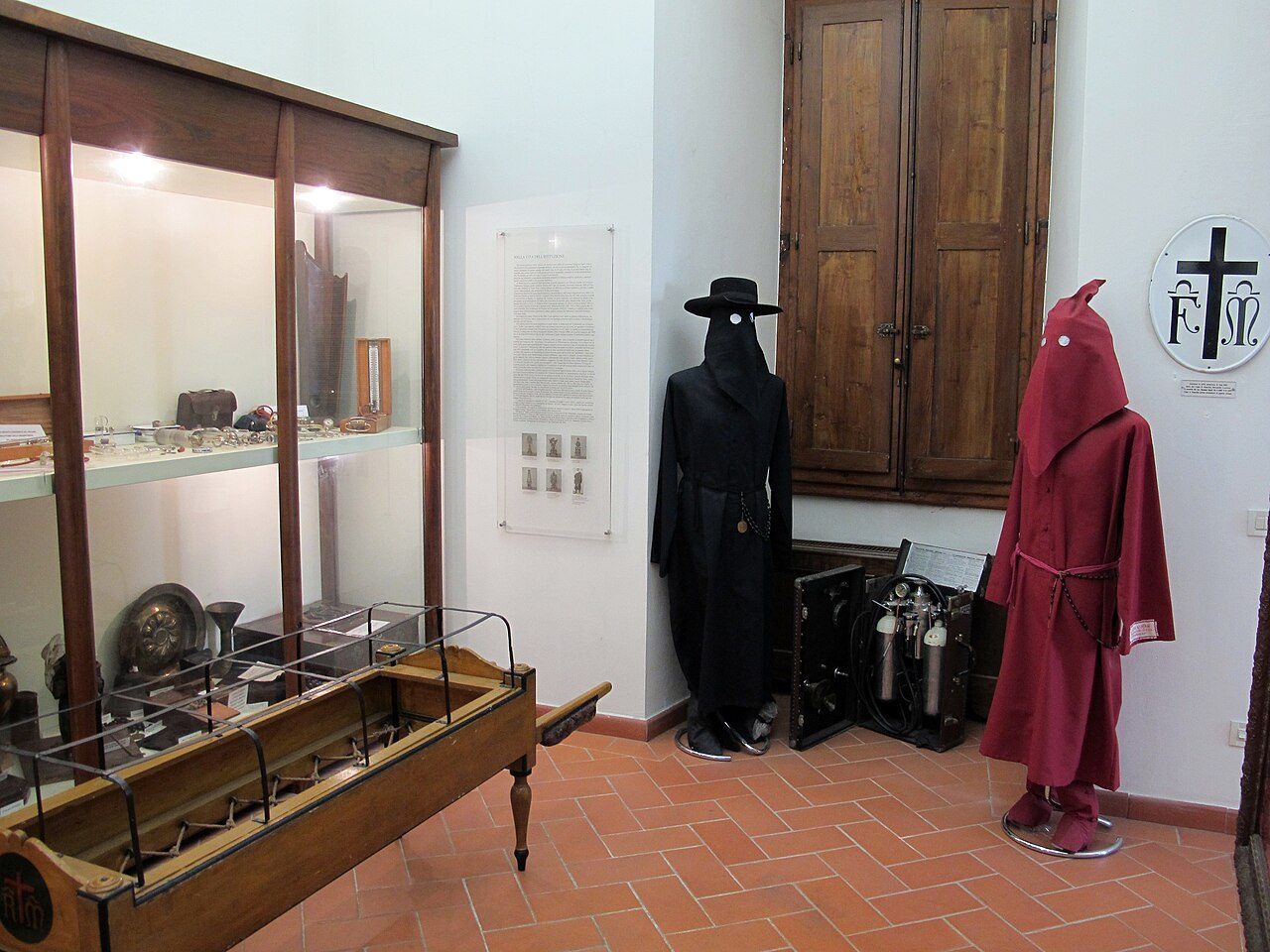
The black «buffa» and the historic red robe, Museum of the Misericordia of Florence.Photo: Sailko · CC BY 3.0 · Wikimedia Commons From the very beginning the confratelli wear a service robe that makes them look alike, whatever their wealth: a cloak called the «buffa» that covers the face, with gloves and gaiters, to keep the helper anonymous according to the Gospel principle «do not let your left hand know what your right hand is doing». Originally red, in memory of the Holy Spirit, from 1495 it becomes black as a sign of penance: it is the historic robe still handed over today during the Vestizione, the investiture ceremony. - 1498 Around the world
The Holy Houses beyond the borders
The Florentine example crosses the Alps and the sea. In Portugal, Queen Eleanor (Leonor) promotes the founding of the Misericordia of Lisbon in 1498: the Santas Casas da Misericórdia spread rapidly and, with the navigators, reach the colonies, from Brazil to Mozambique, from São Tomé to Macau. The charity of the Misericordie becomes, in effect, a worldwide phenomenon. - 1500 – 1700 The Renaissance
Medici and Popes as protectors
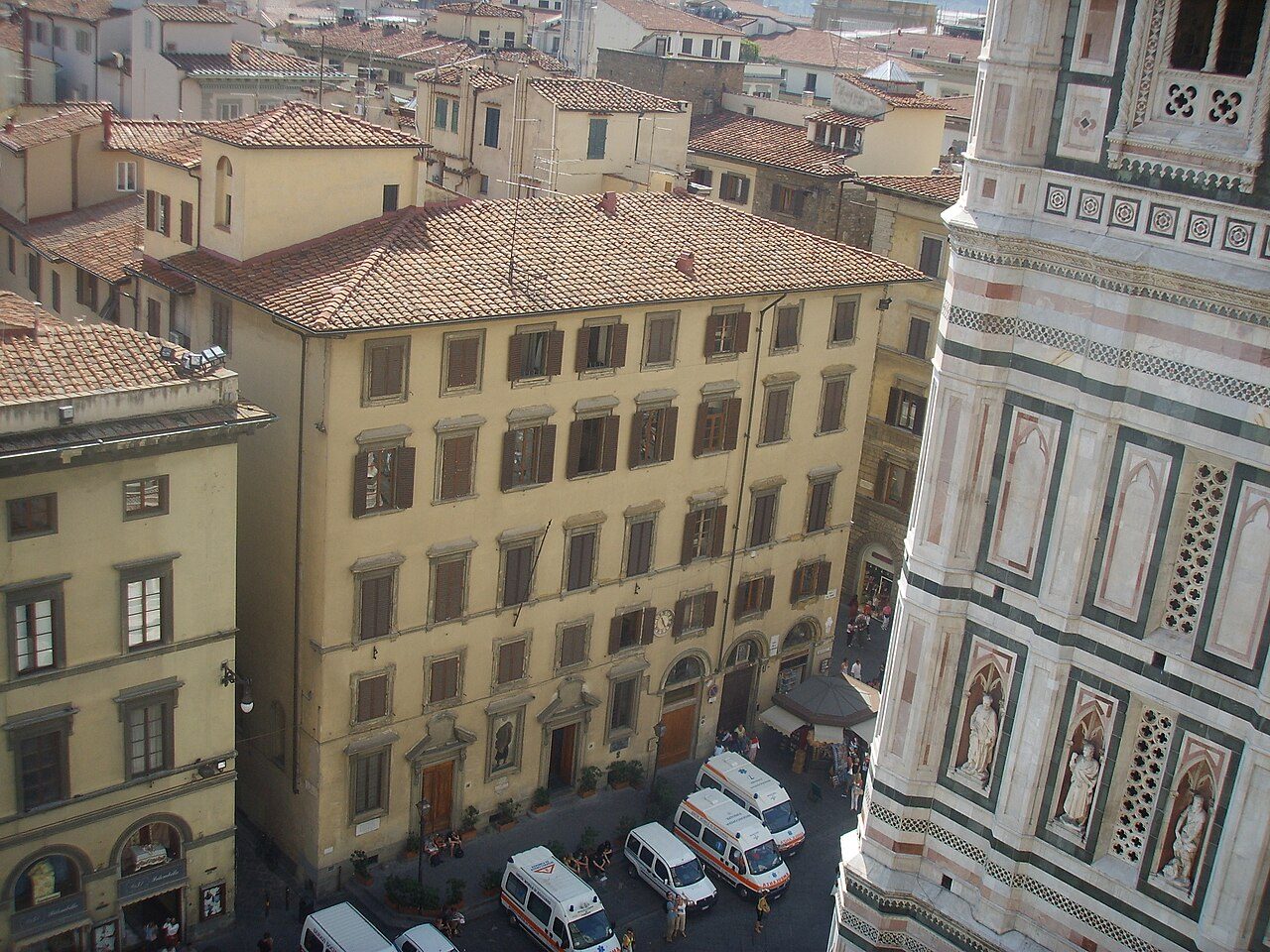
The historic headquarters of the Misericordia of Florence, opposite the Cathedral.Photo: Sailko · CC BY 2.5 · Wikimedia Commons In the golden centuries of Florence, princes and popes place themselves at the service of the Company. Clement VII grants it a church (1525); in 1576 Francesco I de’ Medici donates the headquarters opposite Giotto’s bell tower, still in use today; Cosimo III donates the statue of Saint Sebastian, patron of the Misericordia. And yet, under the «buffa», grand duke and commoner remain indistinguishable: they give the same, identical service. - Saint Sebastian The tradition
The patron who protects from contagion
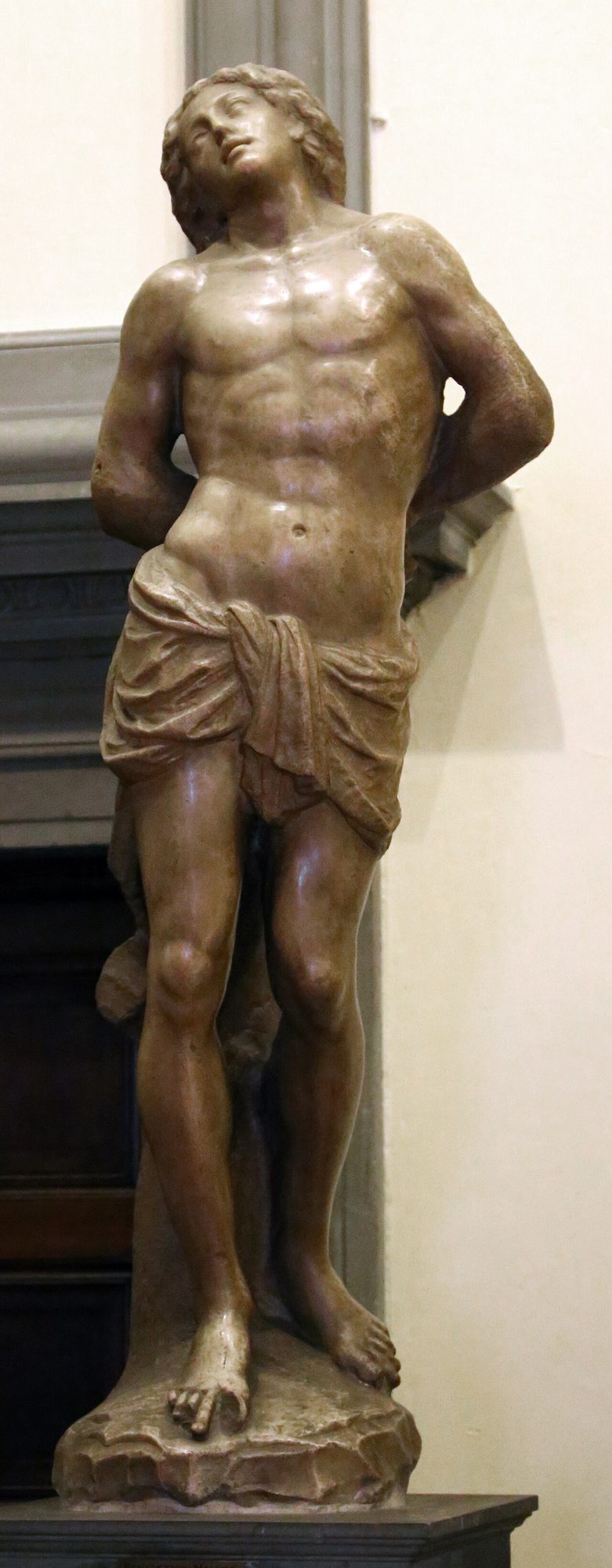
Saint Sebastian, patron of the Misericordie, by Benedetto da Maiano.Photo: Sailko · CC BY 3.0 · Wikimedia Commons It is no coincidence that the Misericordie chose Saint Sebastian as their patron, invoked since time immemorial against plague and epidemics. His figure sums up the mission of the Confraternita: to resist evil, to protect the community, and never to give in to the contagion of fear. - 1800 The nineteenth century
Cholera and the spread of the Misericordie
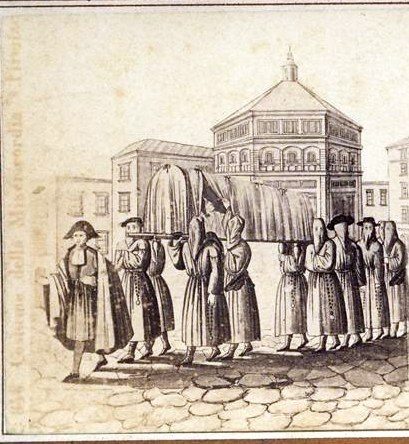
Confratelli in the «buffa» carry a stretcher, Florence. Photo by Giorgio Sommer (19th century).Public domain · Wikimedia Commons The great cholera epidemics of the nineteenth century once again call the confratelli to the front line, among stretchers and isolation hospitals. Meanwhile, following the example of Florence, dozens of new Misericordie are founded throughout Tuscany and beyond: by the middle of the century there are almost one hundred. All of them are «governed by the people» (si governano a popolo), with freely elected bodies, united by the same Gospel inspiration. - 1899 The Movement
The Confederation is born in Pistoia
With the new Kingdom of Italy, the desire to join forces grows. On 24 and 25 September 1899, gathered in Pistoia for their 1st Congress and with the blessing of the Holy Father, the Misericordie found the Federazione delle Associazioni e Confraternite di Misericordia (Federation of Misericordia Associations and Confraternities). This is the date that marks the birth of the Confederation and of the national Movement: individual, ancient confraternities choosing to walk together. - 1903 – 1924 The Movement
Kings and princes among the confratelli
The prestige of the Misericordie carries on into the early twentieth century: in 1903 King Victor Emmanuel III and Queen Elena visit the Confraternita of Florence; in 1924 Umberto of Savoy becomes its «Capo di Guardia» (head of the watch). Signs of a deep bond with the history of Italy, without ever losing the spirit of equality beneath the robe. - The 20th century The modern age
Wars, ambulances, motorisation

From the shoulder-borne stretcher to the motor ambulance: modern emergency medical care. The short twentieth century puts the Misericordie to the test once more: the two world wars, care for the wounded and the displaced, the reconstruction. Meanwhile the shoulder-borne stretcher gives way to the motor ambulance: modern emergency medical care is born, with vehicles, radios and trained volunteers. An ancient charity equips itself with new tools, but the gesture remains the same. - 1966 The modern age
The Florence flood
During the night of 3 to 4 November 1966 the Arno bursts its banks and submerges Florence under a wave of mud. The Misericordie and the public assistance associations (pubbliche assistenze) are among the first to help the flooded city, alongside the «mud angels» (angeli del fango) who rushed there from all over Italy. The tragedy shows how vital organised volunteering is in major emergencies. - 1970 The modern age
Volunteering joins Civil Protection
It is precisely from the experience of the flood that, with Law 996 of 8 December 1970, the first official recognition of the role of volunteering in Civil Protection is born. The Misericordie, which had played that role for centuries, become a full part of the national emergency system: emergencies, disasters, major events. - 1994 In the Castelli Romani
The Misericordia di Ariccia is born
The Misericordia di Ariccia at the side of the Castelli Romani community since 1994. In 1994 the Confraternita di Misericordia di Ariccia joins this very long tradition: young people and adults of the Castelli Romani who choose to serve their community. Health transport, social services, training, Universal Civil Service, help for vulnerable families: the Works of Mercy, here and now. - 2017 Today
The Third Sector Code
With the Third Sector Code (Codice del Terzo Settore, Legislative Decree 117/2017), the Italian law governing non-profit bodies, and the Single National Register of the Third Sector (RUNTS), the Misericordie take on the legal status of Third Sector Entities (Enti del Terzo Settore), often as Voluntary Organisations (ODV). The rules and the transparency change, not the soul: the volunteer remains the most important figure in every Misericordia. - Today Today
A living movement, since 1244

The same ancient vocation, in the square of Ariccia today. Today the National Confederation of the Misericordie of Italy brings together over 800 confraternities, with about 670,000 members and about 80,000 active volunteers. From ambulances to social and health transport, from outpatient clinics to Civil Protection, from social centres to funeral services: the same ancient vocation (to stand beside those who suffer) speaks the language of today. The Misericordia di Ariccia is part of it.
From ambulances to social and health transport, from outpatient clinics to Civil Protection: the same ancient vocation speaks today's language. Want to know more about the roots of the Movement? Read our Story & tradition page.
The story continues with you
Write the next chapter
Eight centuries of charity have reached us thanks to those who, in every age, chose to be there. In Ariccia, too, you can be part of this story.
